This is the Metadyne Website
Automatic Route Setting and the Development of the Programme Machine on London Transport Railways
Automatic Junction Working
and the Programme Machine
London Transport (LT) was at the forefront of automating the signalling of trains at junctions using electromechanical equipment.
The first stage was to develop a robust system for transmitting accurate train descriptions, covered in this article. There were two quite different schemes that sought to use train descriptions to operate the routing of trains automatically, but neither was developed because of operational shortcomings.
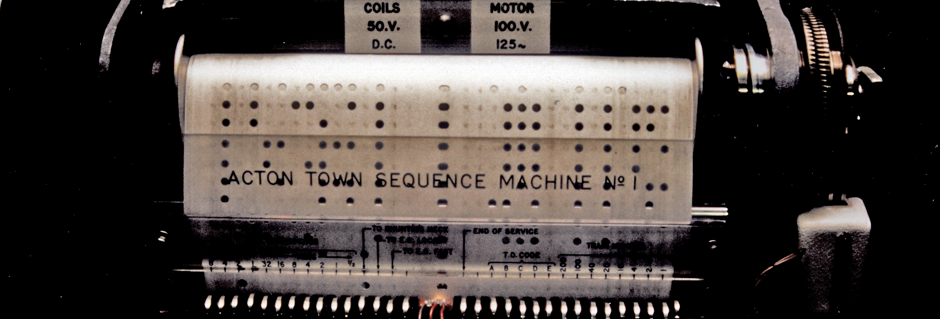
From the late 1950s many operational shortcomings were solved by the development of a machine (a programme machine) which carried the timetable in the form of coded holes on a plastic roll which stepped each time a train approached. This was arranged to check that the destination was correct and, at some locations, that the train was not running early; if both conditions were correct then the machine passed routing instructions to the interlocking equipment which operated points and signals to set up the route. The equipment initially varied considerably from one site to another, and over time adopted a huge number of electronic control techniques that superseded the early deployment of relays. Some 40 sites were eventually equipped with programme machines.
Any comments, or additional information, will be especially welcome.
This article explains how the programme machine sites were introduced and developed and is believed to be the only occasion where the whole story has been set out.
A few words are also said about the introduction of positive train identification on the Northern Line, requiring the introduction of computers, which are still in use.
The writing has probably gone as far as it can, but the author would be keen to include anything material that may have been missed.
With resignalling of the Northern, Victoria and District Lines in hand, the end of the programme machine is in site, though there are still dozens in service. It is perhaps a fitting moment for the story to be told.
Download article
To download the article about programme machines and automatic junction working on the Underground, please click the button below. Please give the above download several seconds to arrive as it is at least a large-ish file. If you experience a problem using the button, there is an alternative link at the bottom of the column. You may find it helpful to avoid Google Chrome, which I have found to be troublesome with pdf files.